 Highest quality - Made in Germany
 Years of expertise since 1984
 Certified & Tested

Basics for buying an agitator
Do you need an agitator? But you're not quite sure how to approach the task? Then you've come to the right place.
The selection of a suitable agitator can be easily determined with the help of a few criteria. Once you have defined these criteria for yourself, selecting the right agitator and components is just a matter of hard work. With these few details, we can offer you an agitator that is perfectly tailored to your mixing task within a very short time. And you can be sure that you will get a perfect stirring result. Find out what these points are now:
1. what needs to be stirred?
Important first: Which substance needs to be stirred? Are they solid substances such as powder or granules? Liquids such as water, oils, flavors? Or do you have a mixture of two different substances, solids and liquids or liquids and gases? This primarily influences the choice of agitator and the performance of the agitator drive. And that brings us to the next section:

2. what is the viscosity and density of the material to be stirred?
In connection with point 1, the viscosity, i.e. the viscosity of the stirring substance, can now be determined. If the viscosity is high, the substance is more viscous, like honey. If it is low, the substance is therefore more liquid, like water (For a more detailed explanation, please also read our article on viscosity in our PTM Wiki.). The viscosity has a strong influence on the performance of the agitator drive to be selected. Higher viscosity requires higher torque.
The same applies to density. Media with different densities can also be present in an agitating substance. For example, when granules or powder have to be added to liquids. Substances with a higher density, i.e. the granulate or powder, sink to the bottom. The mixing process, i.e. the distribution of solids in liquids, is called Suspend. Solids can also have different densities. The mixing process is called Mixing solids. Make sure you use the right agitator for such processes. Agitators with high shear forces, such as the dissolver disk, are perfect for breaking up solids and distributing them in a liquid. Spiral agitators ensure optimum mixing of solids.
Points 1 and 2 together will tell you which stirring task applies to you. Details can be found under point 3:

3. what is the task?
Your previous considerations indicate what the actual task of the mixing process is. Do you need high shear forces and a strong air intake to achieve effective mixing? Or should the mixing process be gentle? Do you need to avoid air suction at all costs?
Agitator technology defines various tasks that an agitator can perform. This can be:
Liquid-liquid dispersion, Gas-liquid dispersion, Suspend, Homogenize, Mixing solids or the Heat transfer. Read our knowledge articles on this in our PTM Wiki, in which we present these processes to you in detail.
Each of these processes places its own unique demands on the Flow behavior in the tank (laminar or turbulent), Flow profiles the agitators (axial conveying, radial conveying or tangential conveying) and necessary installations or superstructures, such as heating or cooling coils or baffles.
4. what quantity must be stirred?
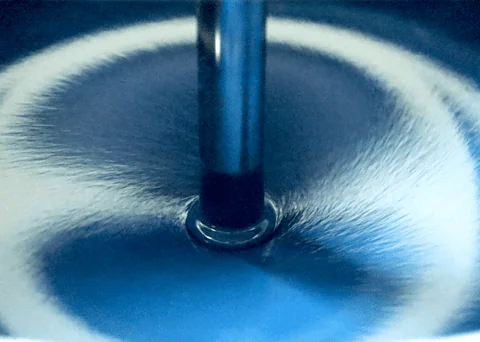
The quantity of agitated substance not only has a significant influence on the dimensions of the agitator, i.e. the size of the agitator shaft, the agitator element or the stand. The power of the motor must also be adapted to the quantity. Logically, you need more power and torque the larger the quantities you have to stir.
5. which containers are used?
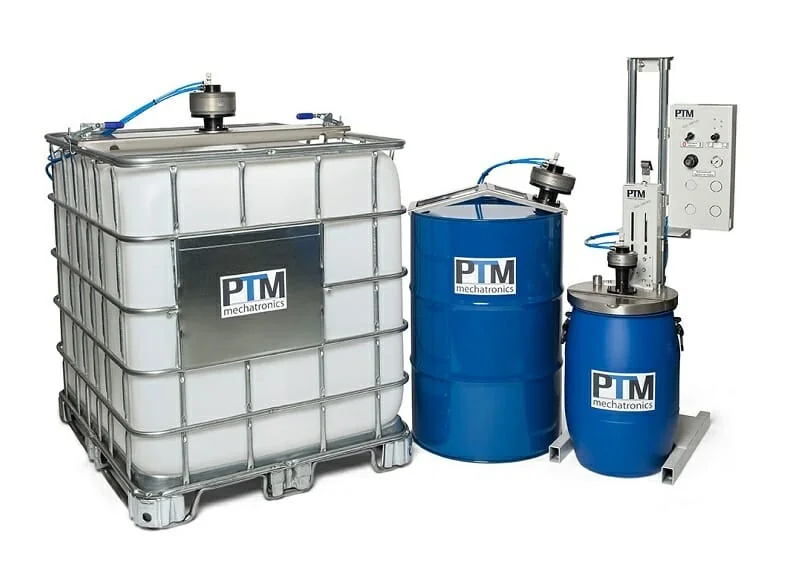
Standardized containers are often used in agitator technology. Small to medium-sized agitators are usually hobbocks (approx. 30 l), drums (approx. between 100 and 500 l) or large IBC containers (approx. 600 to 1,200 liters). Of course, there are also large systems with thousands of liters, such as waste water treatment. The size of the container primarily defines the size, shape and number of agitators and the agitator shaft length.
The type of container also determines the design of the agitator on the container. Do you need a Traverse or a cover? Or can you opt for a comfortable Agitator with lift back?
Of course, there are also special containers that do not comply with the standard, such as chemical process containers. These containers have specific openings for additional applications. Special, industry-typical flange solutions are often used, such as DN flanges, TriClamp or threaded milk connection.
6. is there a special environment or are there special requirements?
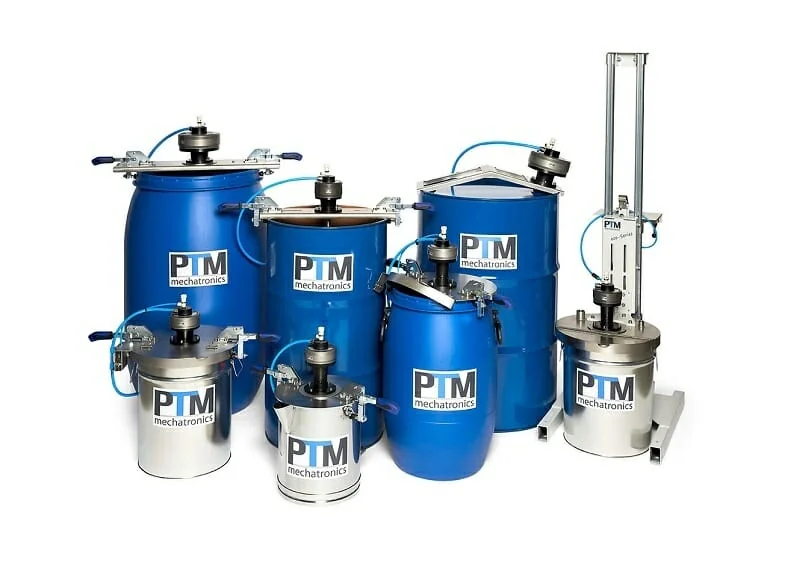
The process, the mix or the environment may mean that the mixing process is subject to special requirements. For example, explosive gases may be produced during agitation, as is often the case in the chemical industry. In this case, your agitators require ATEX-certificates. Some processes are hygienically critical, for example in the food, cosmetics or pharmaceutical industries, and require the sterile environment of a cleanroom and the ability to sterilize components. The guidelines for pharmaceutical and food conformity must be observed. The Protection class IP67 plays a role in applications in damp environments or those that require frequent wet cleaning.
This in turn influences the material and properties of the agitators themselves, as well as the components that come into contact with the media, such as the agitator shaft, agitator element and container. For example, ATEX-certified agitators are used for special requirements, while robust materials are used for hygienic applications. stainless steel. In some cases, additional structures are required to create the special environment, such as extraction systems.
7. upstream and downstream components
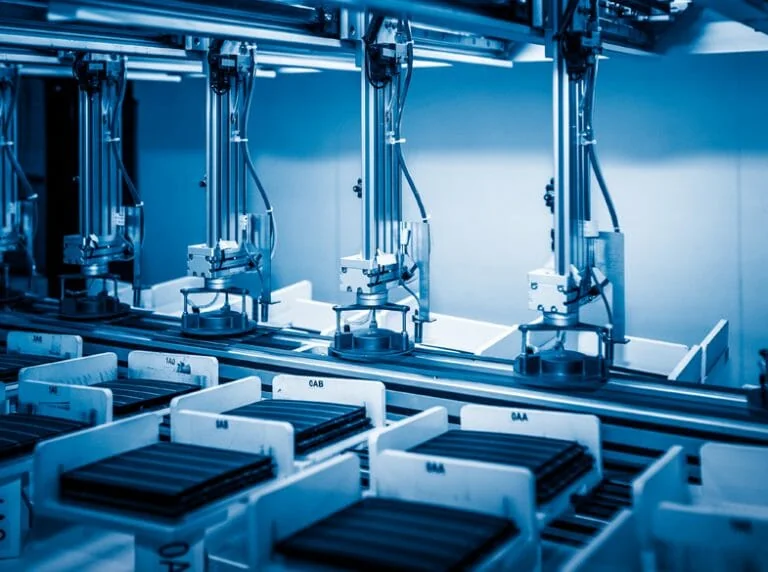
Stirring applications are supplemented by upstream and downstream components, such as for adding substances or removing the mix. These include dosing devices, measuring sensors, filling systems, scales, collecting grids, etc. You can find detailed information on this in our Plant engineering.
Once you have thought through these criteria, you are already a good deal closer to your agitator.
Of course, we will also be happy to go through these criteria with you personally. The important thing is that you end up with your perfect mixing result.

Contact & advice
Would you like advice on our products? Our experts will be happy to take care of your request:
info@ptm-mechatronics.com
+49 8134 / 25 797 0
You can also visit us at


