Highest quality - Made in Germany
 Years of expertise since 1984
 Certified & Tested

Dispersing liquid-liquid
Liquid-liquid dispersion is the process of producing a dispersion. A dispersion is a finely dispersed mixture of at least two normally immiscible liquids. A good example of an everyday dispersion is the long-term stable emulsion, an oil-water mixture. If oil is poured into water, the oil initially floats on the surface of the water without mixing with it. The oil is the so-called inner phase, the water the outer phase.
In order to produce a dispersion, high shear forces are used during dispersion. High shear forces are achieved by using an agitator with appropriate properties, such as the dissolver disk, and high speeds. Emulsifiers are used to stabilize the temporary dispersion. Emulsifiers bind the two substances together at the interface, as they can bind to both water and oil in our example of the oil-water emulsion. This turns the dispersion into a long-term stable emulsion.
Even an emulsion always remains unstable, i.e. it dissolves into its components again after a relatively short time.
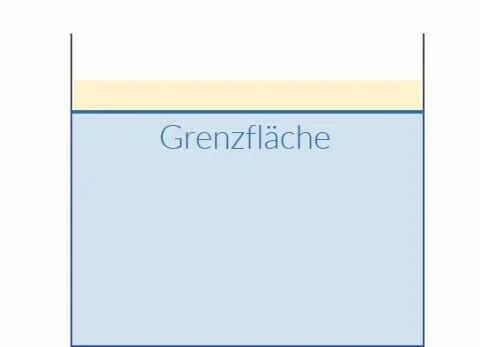
Oil on water unmixed
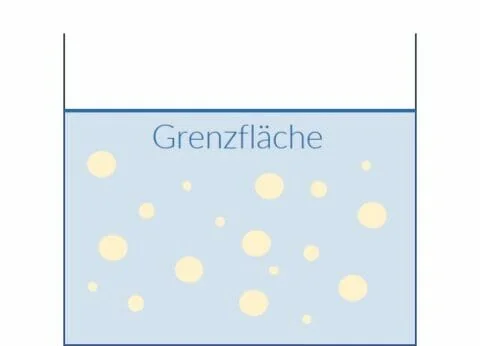
Oil-water emulsion
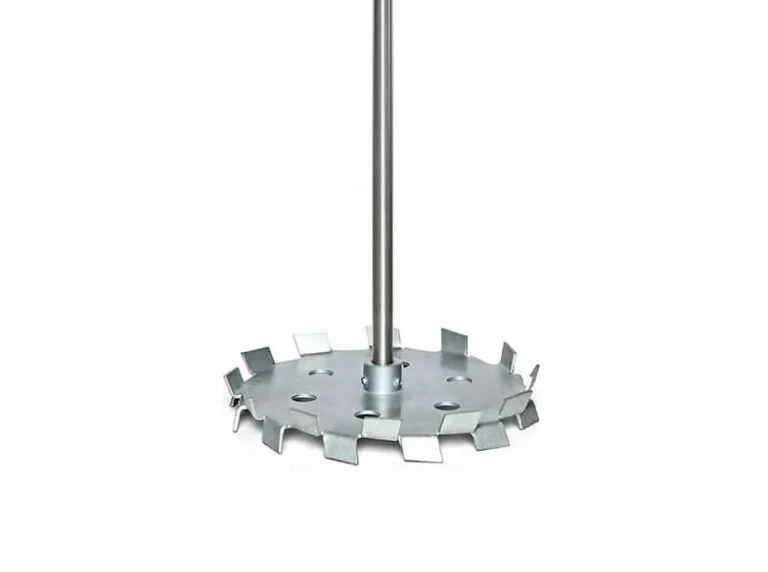
Dissolver disk