Highest quality - Made in Germany
 Years of expertise since 1984
 Certified & Tested

Dispersing gas-liquid
Gas-liquid dispersion is the separation of gas bubbles in a liquid, also known as gassing. The aim is to create the largest possible mass transfer surface between the gas and the liquid. In simple terms, this means that the gas should be distributed in the liquid in such a way that as much liquid as possible comes into contact with the gas. The opposite would be the case, for example, if the gas were only applied to the surface of the liquid. Consequently, only the surface of the liquid would come into contact with the gas and only the surface would react with the gas.
The contact between gas and liquid should then lead to a reaction. These reactions are required in the biotechnology, chemical and pharmaceutical industries. Examples of this are hydrogenation (the addition of hydrogen), oxidation (the addition of oxygen) and fermentation (aerobic: addition of oxygen). Dispersing can also be used to replace one gas in the liquid with another.
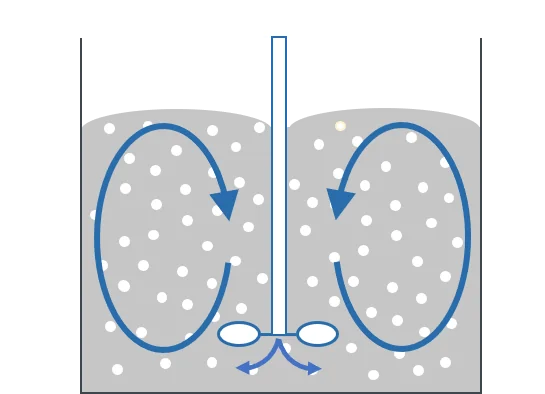
In an optimal gassing process, the gas is broken up into as many small gas bubbles as possible. These are then distributed as evenly as possible in the liquid without creating other counterproductive processes, such as foaming. The gas can be introduced via the surface, via a hollow shaft (see diagram) or via an additional line with pressure.
Gassing via hollow shaft