 Highest quality - Made in Germany
 Years of expertise since 1984
 Certified & Tested

Stirring and saving costs on a grand scale
In the chemical, food, pharmaceutical and cosmetics industries, it is becoming increasingly important to identify and exploit potential energy and cost savings in the production process.
Stirring is a core process in many production and processing steps in the food, pharmaceutical, cosmetics and chemical industries. Depending on the technology currently in use, the potential energy savings are enormous. But it often goes unnoticed. A pity for the environment. But above all expensive for the operator. Because inefficient systems can quickly blow hundreds of thousands of euros into the air completely unnecessarily. „Saving energy and costs currently only plays a subordinate role, especially for plant manufacturers, but also for operators of agitators. Yet there is enormous potential here. Saving energy is a highly topical issue,„ says PTM Managing Director Carsten Angermeyer. The Czech company shows how things can be done differently Plakor in cooperation with PTM mechatronics GmbH.
Vane motors - the secret cost guzzlers
Plakor, based in Moravia, Czech Republic, is one of the world's leading suppliers of automotive plastics. Its product range includes bumpers, spoilers, dashboards and high-quality interior and exterior components. The stirring of paints is therefore one of the core processes in daily operations.
At Plakor, 120 agitators stir paint in 200 liter drums in continuous operation. Before switching to PTM mechatronics, Plakor used standard vane motors. Vane motors are inexpensive to purchase. This makes them interesting at first glance. The receipt for their use comes afterwards - with the electricity bill. In continuous operation, Plakor's vane motors consumed a lot of energy and cost a lot of money. A more efficient alternative was soon needed. This was found in the economical yet powerful agitator drives from PTM mechatronics. Plakor therefore completely replaced the vane motors in its paint preparation room with PTM agitator drives.
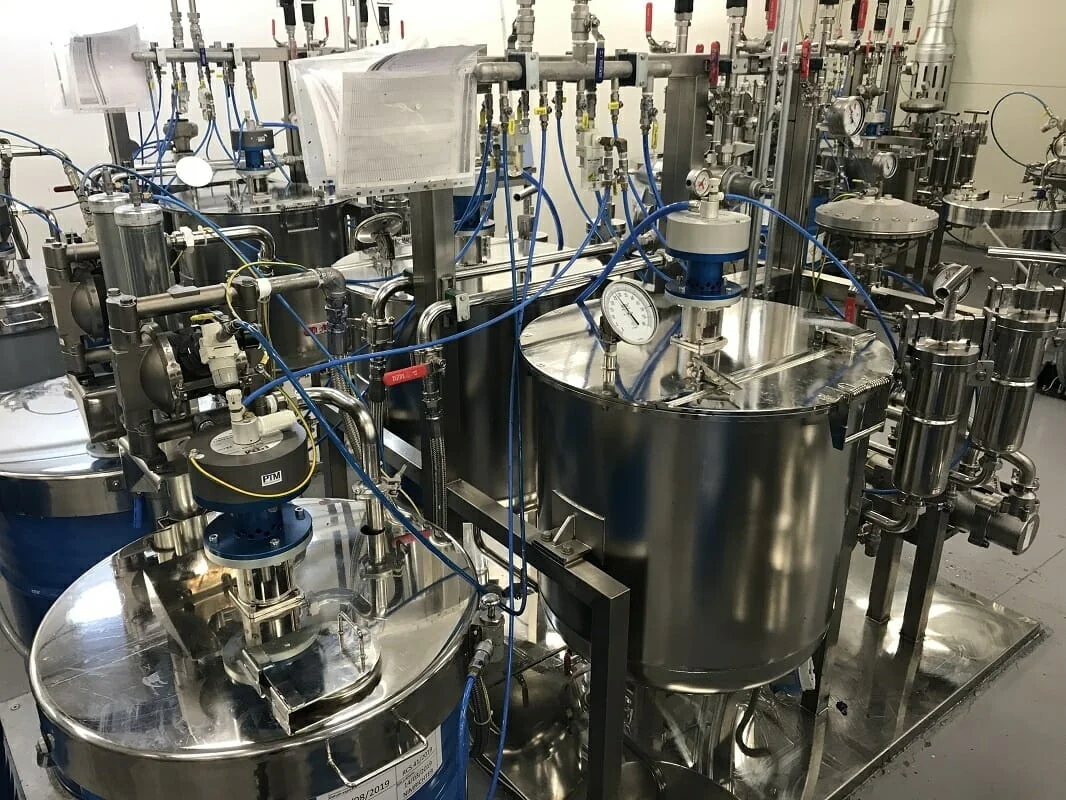
More for the piggy bank with PTM agitator drives
On its own initiative, Plakor subjected the investment in the complete conversion to a 12-month endurance test with various performance scenarios and consumption measurements. The result:
In continuous operation, the 120 new PTM agitator drives save €350,000 in energy costs compared to the old vane motors - per year!
The comparatively low investment costs were amortized within the first year. Plakor stirs at relatively low speeds of approx. 100 rpm. Calculated at the highest speed of 300 rpm, that would be €950,000 per year.
Why is that?
Inside vane motors there is a type of rotor with inclined vanes. The compressed air supplied hits the vanes and drives the rotor. An extremely large amount of compressed air is required to bring the motor up to speed. The vane motor is therefore a high-speed motor with high speed and low torque. This constellation is also completely unsuitable for many mixing substances, as they require gentle processing. This power must therefore be reduced again via a gearbox.
The radial piston principle of the PTM agitator drives, on the other hand, works with cylindrical chambers in which the pistons are pushed towards the housing wall by the compressed air. This is designed in the shape of a wave, which generates the rotary movement. This means that only as much compressed air is required as will fit into the small chambers of the pistons. The PTM agitator drive therefore has a relatively low speed combined with a very high torque. This makes it the perfect agitator drive for stirring substances of all kinds - without the need for a gearbox.
PTM agitators are also unbeatable in terms of stirring results
Plakor only discovered afterwards that radial piston agitators stir much more evenly than vane motors.
Vane motors tend to increase in speed when the fill level in the agitator tank drops. The reason for this is as follows: If the fill level in the agitator tank drops, for example due to draining via a suction lance or evaporation, the resistance of the liquid to the agitator blades of the agitator also decreases as a result. The vane motor reacts to the lower resistance with higher speeds, as it is not braked and the constantly flowing compressed air continues to drive it unhindered, up to 1,500 rpm. Air pockets and, in the worst case, foam form on the surface. For the further processing of the paint, or any other liquid, the resulting air pockets are an obstacle to further processing. They extend the processing time, as they only break down again slowly.
As the fill levels rise, the exact opposite happens: the agitator with vane motor slows down due to its low torque and is no longer able to stir up the solid metallic, color and gloss pigments.
When applied to the product to be painted, air bubbles or solid particles that have settled can cause surface defects and negatively affect the quality of the end product. Water-based paints are particularly susceptible to these phenomena, as their viscosity fluctuates greatly. And their processing already poses serious challenges for the industry.
PTM agitator motors, on the other hand, continue to agitate much more consistently even when the fill level drops. Their maximum technical speed is 300 rpm.
If the fill level in the container rises, the very high torque of the drive reliably maintains the speed.
Plakor therefore established that the stirred paint has neither air inclusions nor deposits and now finally has the quality that is essential for the high demands on process reliability and the end product.
And last but not least, another notable benefit: the massive reduction in compressed air consumption naturally also reduced the operating hours of the compressors. Their maintenance cycles were extended accordingly, which saved even more money.
This success story clearly shows that it is always worth examining the efficiency, suitability and functionality of stirring processes and breaking new ground.
Advice and contact
Find out more about our agitators on our product page here.
We will also be happy to advise you personally on the energy-saving potential of your agitators: +49 8134 25 797 0 or info@ptm-mechatronics.com.
PTM mechatronics - we bring movement into special environments.
Contact & advice
Would you like advice on our products? Our experts will be happy to take care of your request:


